
Hair Transplant for Women: When It Works and When It Does Not
When women may be candidates for surgery, when PRP or medical therapy may be the better route and why a clear diagnosis comes before any procedure.
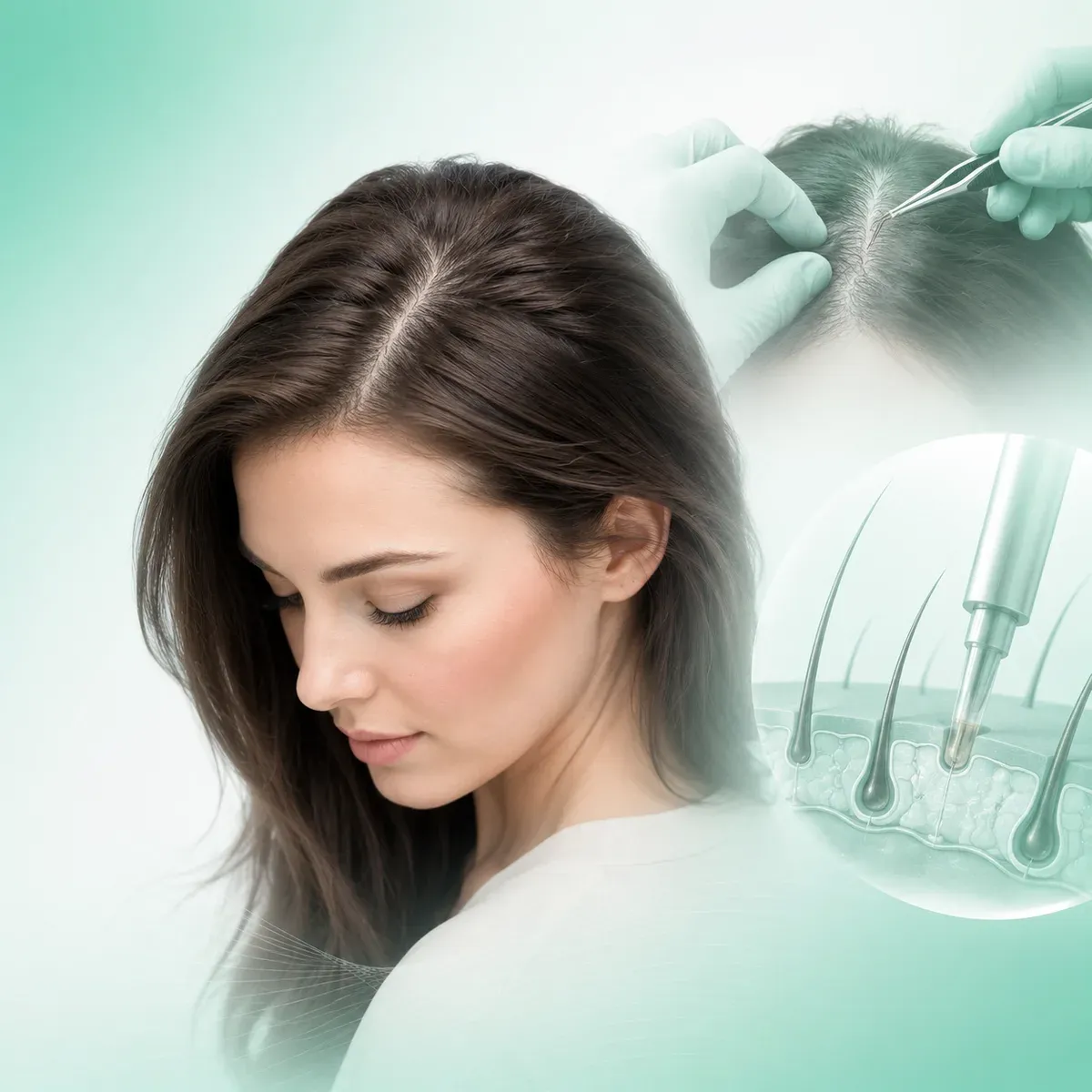
Hair transplant can work for selected women with stable, defined hair loss and a strong donor area. It may not be appropriate for diffuse, unstable or medically driven shedding. Women should be evaluated carefully before surgery because female hair loss often has multiple possible causes.
Why female hair loss needs a different conversation
Female hair loss is often more complex than male pattern baldness. Many men lose hair in recognizable patterns. Women may experience diffuse thinning, a widening part, shedding, hormonal changes or traction-related loss. A hair transplant does not treat the cause of hair loss. It moves follicles from one area to another. If the cause of loss is still active or the donor area is weak, surgery may not be the right first step.
Common causes of hair loss in women
When a hair transplant may work for women
A woman may be a candidate for FUE if hair loss is stable, the donor area is strong, the recipient area is defined, the cause of loss is understood, expectations are realistic, there is enough donor hair to create visible improvement and the patient understands the recovery timeline.
Examples may include stable traction alopecia, defined hairline recession, scar-related hair loss after evaluation and selected cases of female pattern hair loss.
When it may not be the right first step
Diffuse thinning, postpartum, traction and scarring
Diffuse thinning. Diffuse thinning means the hair is thinning over a broad area rather than one defined bald spot. This is common in women. If the donor area is not stable, transplanting that hair may not produce a reliable result. PRP or medical evaluation may be more appropriate in selected diffuse cases.
Postpartum, traction and scarring. Postpartum shedding is common and often improves over time, so surgery is usually not the first response. Traction alopecia can happen after years of tight hairstyles; if the area is stable and donor hair is strong, transplant may be considered. Scarring alopecia requires careful medical evaluation, and active inflammatory scalp disease may make surgery inappropriate until controlled.
PRP for women and why diagnosis matters
PRP for women. PRP may be considered for selected women with early thinning or diffuse shedding. It is not a guaranteed solution, but it may be part of a plan when follicles are still active. PRP may be discussed when hair thinning is early, the part is widening, shedding is diffuse, the patient is not a transplant candidate yet or the goal is maintenance or support.
Why diagnosis matters. A transplant moves hair. It does not fix thyroid issues, iron deficiency, medication-related shedding or hormonal changes. If the cause continues, the patient may keep losing native hair even after a transplant.
What to send for evaluation
- Front hairline photo.
- Center part photo.
- Top scalp photo.
- Crown photo.
- Donor area photo.
- Timeline of hair loss.
- Shedding history.
- Pregnancy or postpartum history if relevant.
- Current medications.
- Prior treatments.
- Any known medical conditions.
Frequently asked questions
Frequently asked questions
Can women get FUE hair transplant?
Is PRP better than hair transplant for women?
Can postpartum hair loss be treated with transplant?
What if my part is widening?
Can traction alopecia be transplanted?
Do women need to shave their head for FUE?
Not sure which stage you're at?
Start with a free, no-obligation evaluation.