
FUE vs DHI vs Sapphire FUE: What Is the Difference?
What FUE, DHI and Sapphire FUE each describe, where they overlap and why the best fit depends on donor area, hairline design and your goals. A brand name is never the whole procedure.
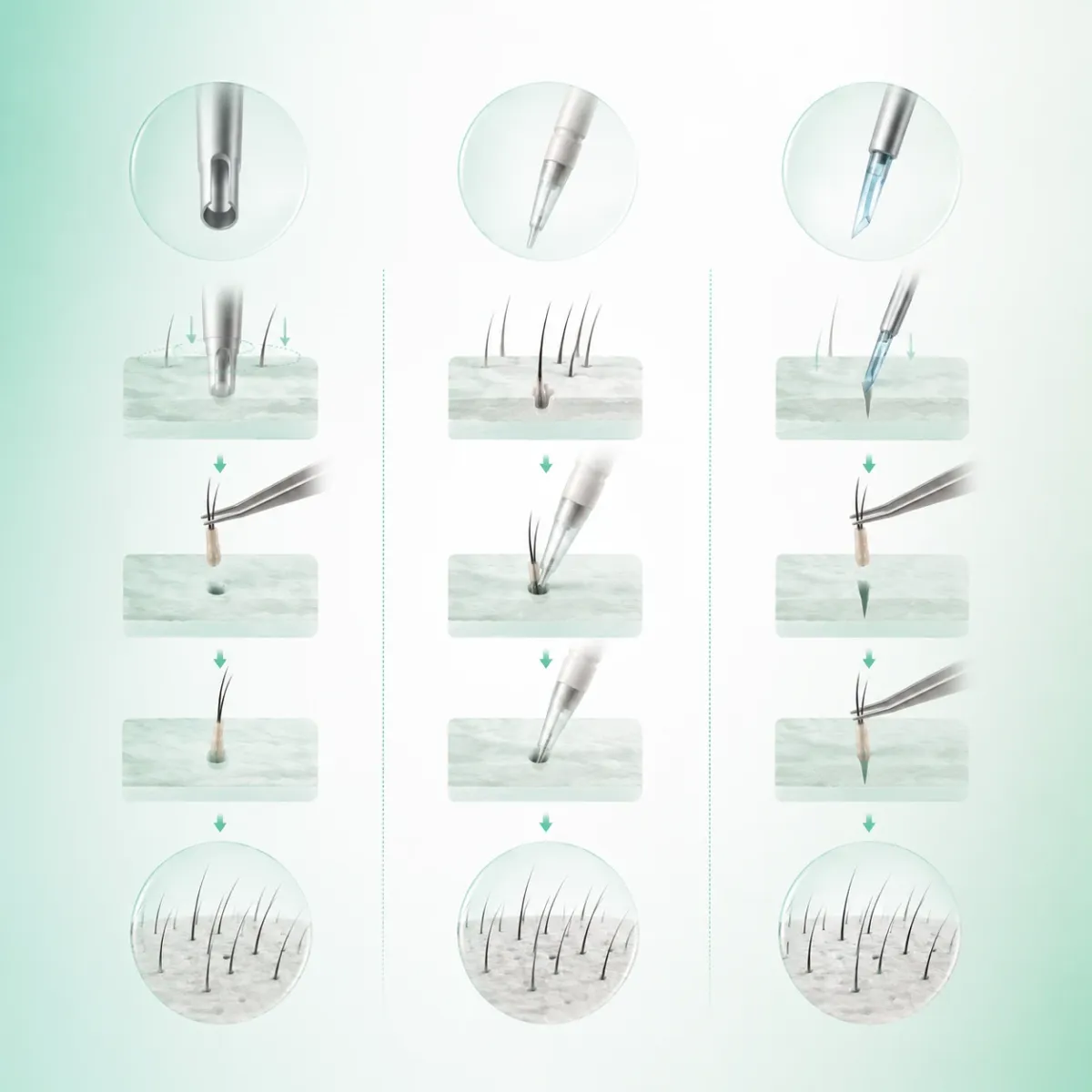
FUE describes how grafts are extracted. DHI describes one way grafts can be implanted using an implanter pen. Sapphire FUE refers to creating recipient channels with sapphire blades. These terms are often marketed as separate procedures, but they can overlap. The best option depends on the patient’s donor area, hairline design, density goals and surgeon’s plan.
Marketing vs medicine
Why patients get confused
Hair transplant marketing often turns technique names into selling points. Patients see FUE, DHI, Sapphire FUE, micro FUE and hybrid methods presented as different procedures. But the tool is not the whole procedure. A natural result depends on many steps that no brand name can guarantee.
- Candidacy
- Donor area quality
- Hairline design
- Graft extraction
- Graft handling
- Recipient site angle
- Density planning
- Surgeon judgment
- Aftercare
- Follow-up
The three terms
What each name actually means
FUE
ExtractionFollicular Unit Extraction. Individual follicular units are removed one by one from the donor area, usually the back and sides of the scalp, instead of removing a strip. This avoids a linear scar, although small circular extraction marks may still occur. Commonly used for hairline restoration, crown thinning, mid-scalp density, beard and eyebrow transplant.
DHI
ImplantationDirect Hair Implantation. In many clinics it means placing grafts with an implanter pen, often called a Choi implanter, which can help control angle and placement in selected areas. DHI is not automatically better for every patient. The same tool can produce different results depending on who uses it.
Sapphire FUE
Recipient channelsSapphire blades are used to create the recipient channels, the small openings where grafts will be placed, aiming for precise channels with less tissue trauma in selected cases. A sapphire blade does not replace surgical judgment: angle, direction, density and graft selection still matter.
Combining methods
Can these techniques be combined?
Yes. A single case may involve FUE extraction, sapphire channel creation, DHI-style placement in selected areas and manual placement in others. This is why the TJ Hair System uses the concept of Hybrid FUE. The technique should serve the patient’s case instead of forcing every patient into one branded method.
This table is not a diagnosis. A physician review is required.
By goal, not by name
Which technique is best for…
The hairline?
It depends on the patient, not the tool. A natural hairline needs:
- Single-hair grafts at the front
- Correct angle and an irregular pattern
- Age-appropriate placement, soft transition
- Donor preservation and long-term planning
The key is not the name of the method. It is whether the hairline looks natural and ages well.
Density?
Density depends on more than technique:
- Hair caliber and hairs per graft
- Donor density and recipient area size
- Graft survival and placement pattern
- Existing native hair and future loss risk
Multi-hair grafts are often used behind the hairline and in the crown; single-hair grafts at the front.
The crown?
The crown is difficult because hair grows in a swirl pattern. Restoring it requires:
- Careful angle and direction planning
- Often a large number of grafts
Some patients are better served by restoring the hairline first and saving crown work for a second stage.
Before choosing a technique
Why “best technique” is the wrong first question
A better first question is: what does my case need? Only after those answers are clear does technique selection matter, and by then, it is usually a decision the surgeon can explain rather than a label to shop for.
- Am I a candidate?
- Is my donor area strong enough?
- Is my hair loss stable?
- What area should be prioritized?
- Do I need surgery, or PRP first?
- What result is realistic?
- How will future loss be managed?
FAQ
FAQs
Is DHI better than FUE?
Is Sapphire FUE better than regular FUE?
What is Hybrid FUE?
Which technique gives the most natural hairline?
Can I choose the technique myself?
Wondering which technique fits you?
Start with a free, no-obligation evaluation.